This has been bugging me for quite a while. The issue is too well-known to many artists: (un) supportive environment.
Regardless of your circumstances, there is one thing to be aware of : if you don't give up on yourself, you will always win in the end. If you have the desire to create, you need to know that it's a rare gift; few people have the courage to practice and develop it.
I'm sharing this with those who have the same drive and passion as I do, yet are not blessed with the loving and supportive environment that almost every successful artist had by virtue of having a caring family, or by creating it themselves. Becoming a good artist is not easy; some say it's as difficult as becoming a neurosurgeon. It goes without saying, there will be many setbacks and "failures" along the way. But those are not real failures, they are lessons to show you what you need to improve in your art; we all have to deal with these problems: hours and hours of additional practice makes those flaws go away. It's not impossible.
The only real failure is to stop trying, surrendering and giving up.
Being an artist is not just a profession or a craft, it's who you are.
It's a lot like being left-handed: you can be re-trained, you can learn
to act just like everybody else, you can write with your right hand all
your life, but it doesn't change the fact that you were born and you
will die a lefty.
Removing the negativity that robs you of the energy and the will to create, surrounding yourself with courage, strength and inspiration: that is the only way an artist can overcome the environment and develop the full potential of the creative being inside.
Never stop trying, never give up.
Friday, December 21, 2012
Tuesday, December 18, 2012
End of CGMA 2012 Fall Quarter
My Dynamic Sketching class is coming to a close. It was incredibly tough and extremely rewarding. I feel I've made tremendous progress in the last 8 weeks. This week is dedicated to tidying up all the work done through the quarter and completing the final redesign.
On that note, here are some highlights from the last 2 months of my training:


Not only did I make a few nice drawings, I also get to put my design skills to good use.
For the final redesign (the submersible craft) I decided to make a full circle and use a very basic organic shape. My goal was to apply all the techniques and principles that I've learned in the past 2 months and turn a simple abstract shape into a representation of an object. I hope the final result makes sense.
On that note, here are some highlights from the last 2 months of my training:


Not only did I make a few nice drawings, I also get to put my design skills to good use.
For the final redesign (the submersible craft) I decided to make a full circle and use a very basic organic shape. My goal was to apply all the techniques and principles that I've learned in the past 2 months and turn a simple abstract shape into a representation of an object. I hope the final result makes sense.

Tuesday, November 20, 2012
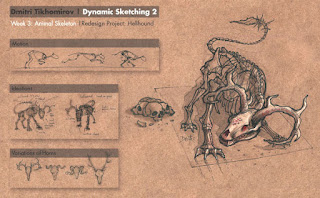
2 weeks of animals
Hi everyone! I've spent the last 2 weeks studying animals. First skeletons and then the real thing. After drawing relatively still subjects for a few months, I was shocked by how much everything moved, especially when I wanted to draw it.
A trip to the zoo gave me new insight into drawing from live models.
In this case, my models were peacocks who couldn't decide if they were more interested in me or pails full of deer feed. It was good to see that bears are as lazy in captivity as they are around my house: lounging around and scratching seemed to be the order of the day.
Here are a few sketches from my time spent at the museum and the zoo.


A trip to the zoo gave me new insight into drawing from live models.
In this case, my models were peacocks who couldn't decide if they were more interested in me or pails full of deer feed. It was good to see that bears are as lazy in captivity as they are around my house: lounging around and scratching seemed to be the order of the day.
Here are a few sketches from my time spent at the museum and the zoo.


Tuesday, November 6, 2012
It's all about bugs
My new CGMA quarter started. I'm taking advanced dynamic sketching and principles of perspective.
This past week my sketching class was all about bugs. I had to produce 6 pages of drawings with 3 final pages being clean renderings of bugs and 1 page featuring a bug-based conceptual design.


This past week my sketching class was all about bugs. I had to produce 6 pages of drawings with 3 final pages being clean renderings of bugs and 1 page featuring a bug-based conceptual design.


Monday, October 22, 2012
Post-It notes
My new CGMA quarter started and I will need to use my desktop for the upcoming assignments. Since I've been writing code on my Linux laptop and doing art with real media, my computer desk turned into a makeshift repository for everything that didn't fit anywhere else in the room. As I was going through months of piled up paper, spare light bulbs and unused art supplies, I found a stack of post-it notes.
When I started training with Jonathan, I had to write everything down: my teacher uses very specific procedures and methods. As I was pushing past my limits, I was making notes so I wouldn't forget important things while being under stress. My notes were quite random, but they usually covered observations of my progress, helpful perspective on things that frustrate me in my training, and a bunch of art-related ideas.
I know I will eventually throw these notes out, so before it happens, I think I should put them here. They might help me in the future and maybe somebody else will find them helpful as well.
Some of these notes are quotes from books, some from movies some came out of my own head, it's a mess, so I apologize for not giving credit to the those who wrote the original text. If it's any consolation, you've helped me through some tough times and I'm eternally grateful to you for sharing your insight.
"2 values in the dark, 3 values in the light. Squint to 10% to establish relationships & shapes, not value or color."
"Simplify all area down to 5 values: black, dark, mid, bright, white. Simplify all edges down to 5 types: soft, medium-soft, medium, medium-hard, hard "
"Observe areas, not shapes. Pay attention to size and placement, not contour and position. Everything is always relative"
"Look for what's wrong, not for what's right. What you would do better."
"If I can learn to see opportunity as fast as I can see the faults of others, I will succeed in a very short time"
"Focus on large areas first, observe size and placement; Size and place correctly all negative space around focus area; Then place all the small shapes: positive and negative, within the large area. When small shapes click, they will adjust and define the shape of the large area, so don't waste time on completely defining the large area beforehand"
"'Creaturize' & 'letterize' large positive and negative spaces. Then do the same for small included shapes"
"27 to 30 days are required for body-mind re-adjustment and adaptation. Be patient, do not expect immediate results! Continuous work without skipping a single day during this period will trigger the desired change"
"
- Take your time with everything
- Relax into practice and routine
- Practice, focus & mileage are everything, speed and 'results' are nothing
- Art is a struggle, struggle between dual opposites is what brings a unified successful result
- Do not worry, doubt, or resent the struggle and frustration. It's a natural part of the process. Accept it for what it is, as it is not an indicator failure or success, nor does it define you
"
"my thoughts while reading Harold Speed:
1. technical excellence (copy + repetition)
2. Mighty appreciation of form (get inspired + analyze + interpret the feeling for each shape + repetition)
3. Understand and see it as an abstract shape"
"1. Negative space
2. Impression
3. Value relationship
4. Edge relationship
5. Keep tools sharp
6. squint at model"
"Always simplify shapes. squint!"
" 1. Draw 2. Check 3. Correct - always work in this order "
"Size it, place it, then see if it's not right"
"Pressure and time make diamonds"
This should do for now. I'll add a few more notes later.
When I started training with Jonathan, I had to write everything down: my teacher uses very specific procedures and methods. As I was pushing past my limits, I was making notes so I wouldn't forget important things while being under stress. My notes were quite random, but they usually covered observations of my progress, helpful perspective on things that frustrate me in my training, and a bunch of art-related ideas.
I know I will eventually throw these notes out, so before it happens, I think I should put them here. They might help me in the future and maybe somebody else will find them helpful as well.
Some of these notes are quotes from books, some from movies some came out of my own head, it's a mess, so I apologize for not giving credit to the those who wrote the original text. If it's any consolation, you've helped me through some tough times and I'm eternally grateful to you for sharing your insight.
"2 values in the dark, 3 values in the light. Squint to 10% to establish relationships & shapes, not value or color."
"Simplify all area down to 5 values: black, dark, mid, bright, white. Simplify all edges down to 5 types: soft, medium-soft, medium, medium-hard, hard "
"Observe areas, not shapes. Pay attention to size and placement, not contour and position. Everything is always relative"
"Look for what's wrong, not for what's right. What you would do better."
"If I can learn to see opportunity as fast as I can see the faults of others, I will succeed in a very short time"
"Focus on large areas first, observe size and placement; Size and place correctly all negative space around focus area; Then place all the small shapes: positive and negative, within the large area. When small shapes click, they will adjust and define the shape of the large area, so don't waste time on completely defining the large area beforehand"
"'Creaturize' & 'letterize' large positive and negative spaces. Then do the same for small included shapes"
"27 to 30 days are required for body-mind re-adjustment and adaptation. Be patient, do not expect immediate results! Continuous work without skipping a single day during this period will trigger the desired change"
"
- Take your time with everything
- Relax into practice and routine
- Practice, focus & mileage are everything, speed and 'results' are nothing
- Art is a struggle, struggle between dual opposites is what brings a unified successful result
- Do not worry, doubt, or resent the struggle and frustration. It's a natural part of the process. Accept it for what it is, as it is not an indicator failure or success, nor does it define you
"
"my thoughts while reading Harold Speed:
1. technical excellence (copy + repetition)
2. Mighty appreciation of form (get inspired + analyze + interpret the feeling for each shape + repetition)
3. Understand and see it as an abstract shape"
"1. Negative space
2. Impression
3. Value relationship
4. Edge relationship
5. Keep tools sharp
6. squint at model"
"Always simplify shapes. squint!"
" 1. Draw 2. Check 3. Correct - always work in this order "
"Size it, place it, then see if it's not right"
"Pressure and time make diamonds"
This should do for now. I'll add a few more notes later.
Friday, October 19, 2012
Fechin master copy
Just finished a master copy of Fechin's "Angry Woman". I still need to work on my proportions, but I put it together and that's what matters.
My next copy is Pierre-Paul Prud'hon. Stylistically, it's the exact opposite of Fechin, so we'll have to see how well I do.

My next copy is Pierre-Paul Prud'hon. Stylistically, it's the exact opposite of Fechin, so we'll have to see how well I do.

Tuesday, October 16, 2012
Paris sketch
I'm working through Ernest Watson's Course in Pencil Sketching. Watson's manual is amazing: it feels like you are sitting next to him, while he explains the material and shows different ways to approach the assignments.
After finishing a few projects, I decided to put my skills to the test and sketch something challenging. I picked Paris as my location and here is what I ended up with

It's based on a photograph from 1925 I found on the web. I changed perspective, viewing angle and elevation. I focused the composition on the street corner area. My intention was to start at the corner, guide the eye to the Eiffel tower and gently return back to the street corner.
I think I accomplished what I set out to do and got to see where I need to improve. This ended up being a great learning experience for me, and now I feel even more enthusiastic about Ernest Watson's course.
After finishing a few projects, I decided to put my skills to the test and sketch something challenging. I picked Paris as my location and here is what I ended up with

It's based on a photograph from 1925 I found on the web. I changed perspective, viewing angle and elevation. I focused the composition on the street corner area. My intention was to start at the corner, guide the eye to the Eiffel tower and gently return back to the street corner.
I think I accomplished what I set out to do and got to see where I need to improve. This ended up being a great learning experience for me, and now I feel even more enthusiastic about Ernest Watson's course.
Subscribe to:
Posts (Atom)